

IV
Cortical
Interfaces
Optogenetic
Cortical
Interfaces
Worldwide, approximately 63 million people are affected by vision loss due to optic nerve atrophy and neuropathy, with a similar number suffering from loss of limb functionality. Currently, there are only inadequate treatment options for these disabling conditions. The team at the EKFZ Center for Optogenetic Therapies focuses on developing closed-loop optogenetic brain-computer interfaces (oBCIs) aimed at restoring vision and enabling skilled movements in hand prostheses. Optogenetic manipulation of brain circuits, widely used in basic neuroscience, is still in the early stages of translation into clinical practice. Challenges with current commercial BCIs include broad current spread and tissue scarring, which reduce efficacy shortly after implantation. However, optogenetic stimulation offers a spatially confined and tissue-penetrating solution.
The EKFZ for Optogenetic Therapies is advancing the development of high-density, closed-loop oBCIs. For vision restoration, this involves targeting specific brain areas that remain functional despite optic nerve damage, initially tested on marmoset models. To restore motor and sensory functions of limbs, the approach involves integrating feedback systems into prostheses to simulate sensory inputs controlled by brain activity. These initiatives involve close collaboration between various research platforms to refine the technology and ensure it is safe and effective for future clinical trials. The long-term goal is extensive preclinical trials on non-human primates to pave the way for clinical testing.
View PDF: Click on the image to open the article as a PDF.
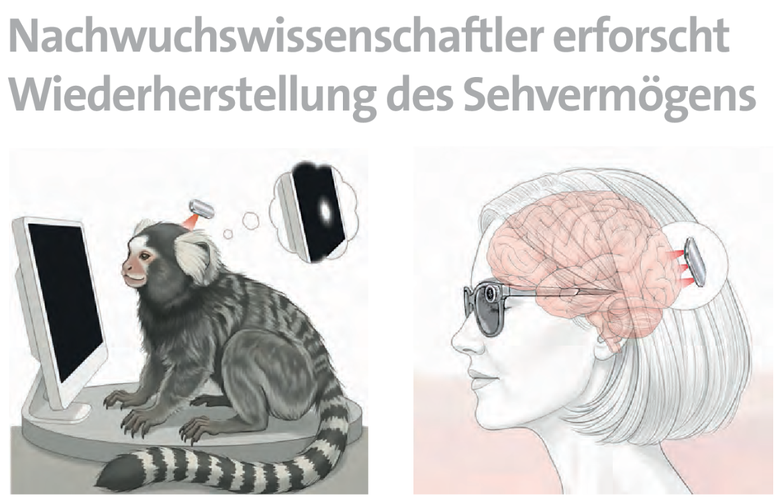

Source: German Primate Center GmbH – Leibniz Institute for Primate Research, 37077 Göttingen


Junior Research Groups
Visual Circuits &
Interfaces
We investigate the neural circuits involved in visual processing and develop optogenetic methods for generating artificial visual perception. Our current focus is on basic research for the development of an optogenetic cortical prosthesis as a novel approach to restoring vision.
A central goal is to understand how structured stimulation of the primary visual cortex can generate meaningful perceptions and how these artificial signals propagate through the visual hierarchy.
To develop these approaches, we combine large-scale electrophysiological investigations, optogenetics, and behavioral experiments in marmosets.
The research group is affiliated with the Institute for Auditory Neurosciences at the University Medical Center Göttingen (UMG).

Integrated photonic
and genetic tools
for optical neurophysiology
In our lab, we integrate genetic and photonic tools to establish all-optical approaches for the non-invasive manipulation and investigation of the activity of excitable cells in the brain. We pursue an interdisciplinary approach by combining protein engineering and patch-clamp electrophysiology to develop tailored genetic tools and integrate them with holographic illumination techniques to perform two-photon optogenetics and two-photon voltage imaging. This enables the development of non-invasive optical physiological approaches that offer both high spatiotemporal precision and high throughput, making it possible to study neuronal dynamics over extended periods of time.
The research group is affiliated with the Institute for Auditory Neurosciences at the University Medical Center Göttingen (UMG).